
|
NEDERLANDS | ENGLISH
|
|
|
|
|


|
|




|
9 februari 2006
|
 mail dit artikel
| mail dit artikel
|
 print
| print
|  
Cartoons controversy based on twisted facts
Imam inserts insulting images
By Daan de Wit
The Dutch in the original article has been translated into English by Ben Kearney Dutch F16's have been deployed to keep the protests against the Danish cartoons from getting out of hand, protests that up until now have cost the lives of 14 people. The Prime Minister of Denmark 'Mr Rasmussen told a news conference in Copenhagen "we are now facing a growing global crisis" over the cartoons', reports the BBC. Iran has cut off trade relations. In spite of all of the excitement, little of the official story -believed by friend and foe alike- appears to add up. What is clear is that a Danish Muslim leader inserted insulting cartoons and other images into the larger collection of Danish cartoons, with which he then went on to generate publicity in the Middle East. '"We're seeing ourselves characterised as an intolerant people or as enemies of Islam as a religion. That picture is false. Extremists and radicals who seek a clash of cultures and religions are spreading it," Mr Rasmussen said.' Which image is fake and who are the extremists? Three insulting images added by Imam On February 2nd The Counter Terrorism Blog wrote that the photocopy was distributed by the Danish imam Ahmad Abu Laban, the head of the Islamic Society of Denmark. Laban, who received little sympathy from either the newspaper or the Danish Prime Minister after the twelve cartoons were published, went on a tour through the Middle East looking to make news, just as he had earlier announced he would: '"We want to internationalize this issue so that the Danish government would realize that the cartoons were not only insulting to Muslims in Denmark but also to Muslims worldwide," said Abu Laban. "It was decided to take such a step because it is wrong to turn a blind eye to the fact that some European countries discriminate against their Muslims on the grounds that they are not democratic and that they can not understand western culture."' The Counter Terrorism Blog revealed that the Muslim delegation then inserted pictures into the series of cartoons from the Danish newspaper: '[...] the Danish Muslim delegation showed much more than the 12 cartoons published by Jyllands Posten. In the booklet it presented during its tour of the Middle East, the delegation included other cartoons of Mohammed that were highly offensive, including one where the Prophet has a pig face. But these additional pictures were NOT published by the newspaper, but were completely fabricated by the delegation and inserted in the booklet (which has been obtained and made available to me by Danish newspaper Ekstra Bladet). The delegation has claimed that the differentiation was made to their interlocutors, even though the claim has not been independently verified. In any case, the action was a deliberate malicious and irresponsible deed carried out by a notorious Islamist [...]'. That portrayal is a possible reference to this statement: '"We love bin Laden, we love Saddam Hussein, and anyone who is willing to destroy the U.S"', said Laban, as quoted in the Jerusalem Post. This also supplies the extremist component to this story - to which the Danish Prime Minister alluded. Flemming Rose, culture editor of the Danish newspaper-in-question, elaborates on this further: '"All of that gratuitous rubbish was trumped around to trigger a campaign of senseless hatred," Rose said. [...] International terrorism expert Lorenzo Vidino, of the Washington, D.C.-based Investigative Project, said he believes the additional drawings "added fuel to the fire." "The original cartoons were offensive, but these were worse," he said. "It was really nasty stuff." Vidino, author of the recently published "Al Qaeda in Europe: The New Battleground of International Jihad," said the portfolio itself made no distinctions between the sets of drawings. "They said they made the distinction in their presentations. Did they? That's impossible to know. But I do know that in Arabic chat rooms, people were talking about the Danes showing pictures of the prophet Muhammad as a pig." Vidino said the group's leader, Ahmed Abu Laban, describes himself as a moderate imam but has past ties to radical Islamists, such as serving as a translator for top al-Qaida aide Ayman al-Zawahri in the early 1990s.' Cui bono? Worldwide retreat into the trench of fundamentalism
____________________________________________________________________________
DeepJournal Meld je aan voor de gratis mailing list. |
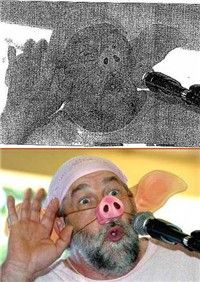 which are reported to be considerably more obscene and were mistakenly assumed to have been part of the Jyllands-Posten set.' One of the pictures concerns a blurry
 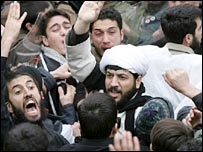 and submitted to by those who, in the face of a glut of disinformation and meaningless news, are in no position to define an alternate course. The logical reaction is to become defensive, and to hold that position by attacking. Examples of this can be seen in the election victory of Hamas, the fundamentalist extremism of the American President Bush and the Iranian President Ahmadinejad, statements by Chirac concerning France's willingness to use nuclear weapons, the 'fundamentalizing' of immigrant youth in The Netherlands, the strained relations between French youth and the French government, and measures introduced all over the world limiting people's freedom. It can even be seen in this
 |
9 september 2013 |
Waarom ligt Syrië onder vuur? - Deel 4
Wie onder de oppervlakte kijkt, ziet dat Syrië onder vuur ligt vanwege de belangen van de betrokken partijen. 'Syrië' gaat over macht, geld, invloed en energie.
8 september 2013 |
Waarom ligt Syrië onder vuur? - 3
Wie vorm en inhoud scheidt, ziet dat de strijd om Syrië vooral niet gaat over waar het over lijkt te gaan. De vorm maskeert de inhoud. Syrië en Iran zijn stukken op een geopolitiek schaakbord.
7 september 2013 |
Waarom ligt Syrië onder vuur? - Deel 2
Bij grote militaire conflicten die aanzienlijke humantaire en economische gevolgen kunnen hebben, is het goed te kijken naar de belangen van de betrokken partijen en naar de rol van de media bij de verslaggeving van de feiten.
6 september 2013 |
Waarom ligt Syrië onder vuur? - Deel 1
Aan de oppervlakte is het duidelijk: de VS willen Syrië bevrijden van een wrede dictator die zijn bevolking met gifgas bestookt. Onder de oppervlakte is er iets heel anders aan de hand.
1 april 2013
Albert Spits: Creëer je eigen financiële veiligheid
Spits beschrijft hoe de euro richting de uitgang gaat en dat je intussen maar beter waarde voor je geld kunt kiezen. Hij raadt iedereen aan zich voor te bereiden op een systeemkrach.
|