
|
NEDERLANDS | ENGLISH
|
|
|
|
|


|
|




|
2 oktober 2007
|
 mail dit artikel
| mail dit artikel
|
 print
| print
|  
Dit artikel is deel van de serie: De komende oorlog tegen Iran
[ 1 - 2 - 3 - 4 - 5 - 6 - 7 - 8 - 9 - 10 - 11 - 12 - 13 - 14 - 15 - 16 - 17 - 18 - 19 - 20 - 21 - 22 - 23 - 24 - 25 - 26 - 27 - 28 - 29 - 30 - 31 - 32 - 33 - 34 - 35 - 36 - 37 - 38 - 39 - 40 - 41 - 42 - 43 - 44 - 45 ]
Attack on Iran: the question is only when and in what form
By Daan de Wit Non-military portion of American attack already begun Bush Administration going ahead with attack plans despite opposition
In a period of increasing criticism, the Bush Administration has to operate in an atmosphere of tension, above all because of Iraq. Seymour Hersh writes that 'The former intelligence official added, "There is a desperate effort by Cheney et al. to bring military action to Iran as soon as possible. Meanwhile, the politicians are saying, 'You can't do it, because every Republican is going to be defeated, and we're only one fact from going over the cliff in Iraq.' But Cheney doesn't give a rat's ass about the Republican worries, and neither does the President."' 'The US president faces strong opposition to military action, however, within his own joint chiefs of staff. "None of them think it is a good idea, but they will do it if they are told to," said a senior defence source', reports The Sunday Times. The former commander of Centcom, the American command center that carries out attack plans, said recently: 'There are ways to live with a nuclear Iran [...] Let's face it, we lived with a nuclear Soviet Union, we've lived with a nuclear China, and we're living with (other) nuclear powers as well.' In his opinion war should be avoided: 'War, in the state-to-state sense, in that part of the region would be devastating for everybody, and we should avoid it - in my mind - to every extent that we can," he said.' He's not alone in this view. Richard Clarke, former anti-terrorism boss, said last year: 'We've thought about military options against Iran off and on for the last 20 years and they're just not good because you don't know what the end game is. You know what the first move is but not the last move'. In April of last year, Joseph Cirincione, at that time the director of the Nonproliferation Project at the Carnegie Endowment for International Peace said: 'A military strike would be disastrous for the United States. It would rally the Iranian public around an otherwise unpopular regime, inflame anti-American anger in the Muslim world, and jeopardise the already fragile US position in Iraq. [...] It would accelerate, not delay, the Iranian nuclear programme'. Newsweek writing in 2004: 'the CIA and DIA have war-gamed the likely consequences of a U.S. pre-emptive strike on Iran's nuclear facilities. No one liked the outcome. As an Air Force source tells it, "The war games were unsuccessful at preventing the conflict from escalating."' 'I don't believe there is a consensus that a surgical strike could be used effectively to disable Iran's nuclear program, or that it would be wise to attempt such a strike', said Intelligence expert Steven Aftergood, Research Director for The Project on Government Secrecy of the Federation of American Scientists, last month. Other sources close to the Bush Administration are also being critical of military conflict with Iran, as is apparent from a recent article in Newsweek: 'The Pentagon worries that another war will break America's already overstretched military, while the intelligence community believes Iran is not yet on the verge of a nuclear breakthrough. The latter assessment is expected to appear in a secret National Intelligence  Estimate currently nearing completion, according to three intelligence officials who asked for anonymity when discussing nonpublic material. The report is expected to say Iran will not be able to build a nuclear bomb until at least 2010 and possibly 2015. One explanation for the lag: Iran is having trouble with its centrifuge-enrichment technology, according to U.S. and European officials.' '[...] Air Chief Marshal Sir Glen Torpy, the head of the RAF, voiced the fear of many British officials that America is too devoted to military solutions. He said: "In an environment like this, we always focus on the part that the military can play in solving security and foreign policy problems, but the military will rarely, if ever, be the solution"', writes The Telegraph. '"The Brits don't trust the Iranians," the retired general said, "but they also don't trust Bush and Cheney." [...] Vincent Cannistraro, a retired C.I.A. officer who has worked closely with his counterparts in Britain [...]: "The Brits told me that they were afraid at first to tell us about the incident-in fear that Cheney would use it as a reason to attack Iran." The intelligence subsequently was forwarded, he said', writes Seymour Hersh. Estimate currently nearing completion, according to three intelligence officials who asked for anonymity when discussing nonpublic material. The report is expected to say Iran will not be able to build a nuclear bomb until at least 2010 and possibly 2015. One explanation for the lag: Iran is having trouble with its centrifuge-enrichment technology, according to U.S. and European officials.' '[...] Air Chief Marshal Sir Glen Torpy, the head of the RAF, voiced the fear of many British officials that America is too devoted to military solutions. He said: "In an environment like this, we always focus on the part that the military can play in solving security and foreign policy problems, but the military will rarely, if ever, be the solution"', writes The Telegraph. '"The Brits don't trust the Iranians," the retired general said, "but they also don't trust Bush and Cheney." [...] Vincent Cannistraro, a retired C.I.A. officer who has worked closely with his counterparts in Britain [...]: "The Brits told me that they were afraid at first to tell us about the incident-in fear that Cheney would use it as a reason to attack Iran." The intelligence subsequently was forwarded, he said', writes Seymour Hersh. A critical view of the Iran issue could for that matter be the reason that Bush's top advisor Karl Rove left the Bush Administration, writes former CIA analyst Ray McGovern on the basis of a part of the column Deep Background by ex-CIA agent Phil Giraldi: 'In short, it seems possible that Rove, who is no one's dummy and would not want to be required to "spin" an unnecessary war on Iran, may have lost the battle with Cheney over the merits of a military strike on Iran, and only then decided -- or was urged -- to spend more time with his family. As for administration spokesperson Tony Snow, it seems equally possible that, before deciding he had to leave the White House to make more money, he concluded that his stomach could not withstand the challenge of conjuring up yet another Snow job to explain why Bush/Cheney needed to attack Iran.'
____________________________________________________________________________
DeepJournal Meld je aan voor de gratis mailing list. |
 writes that the main difference is the rhetoric. '"They've changed their rhetoric, really. The name of the game used to be nuclear threat," Hersh
 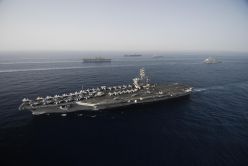 though their airspace. American defence officials are also keen that Iran's Arab neighbours prepare to deal with any Iranian attempt to target them in return.' 'The revised bombing plan for a possible attack, with its tightened focus on counterterrorism, is gathering support among generals and admirals in the Pentagon. The strategy calls for the use of sea-launched cruise missiles and more precisely targeted ground attacks and bombing strikes, including plans to destroy the most important Revolutionary Guard training camps, supply depots, and command and control facilities. "Cheney's option is now for a fast in and out - for surgical strikes," the former senior American intelligence official told me. [...] A Pentagon consultant on counterterrorism told me that, if the bombing campaign took place, it would be accompanied by a series of what he called "short, sharp incursions" by American Special Forces units into suspected Iranian training sites. He said, "Cheney is devoted to this, no question"',
 |
9 september 2013 |
Waarom ligt Syrië onder vuur? - Deel 4
Wie onder de oppervlakte kijkt, ziet dat Syrië onder vuur ligt vanwege de belangen van de betrokken partijen. 'Syrië' gaat over macht, geld, invloed en energie.
8 september 2013 |
Waarom ligt Syrië onder vuur? - 3
Wie vorm en inhoud scheidt, ziet dat de strijd om Syrië vooral niet gaat over waar het over lijkt te gaan. De vorm maskeert de inhoud. Syrië en Iran zijn stukken op een geopolitiek schaakbord.
7 september 2013 |
Waarom ligt Syrië onder vuur? - Deel 2
Bij grote militaire conflicten die aanzienlijke humantaire en economische gevolgen kunnen hebben, is het goed te kijken naar de belangen van de betrokken partijen en naar de rol van de media bij de verslaggeving van de feiten.
6 september 2013 |
Waarom ligt Syrië onder vuur? - Deel 1
Aan de oppervlakte is het duidelijk: de VS willen Syrië bevrijden van een wrede dictator die zijn bevolking met gifgas bestookt. Onder de oppervlakte is er iets heel anders aan de hand.
1 april 2013
Albert Spits: Creëer je eigen financiële veiligheid
Spits beschrijft hoe de euro richting de uitgang gaat en dat je intussen maar beter waarde voor je geld kunt kiezen. Hij raadt iedereen aan zich voor te bereiden op een systeemkrach.
|