
|
NEDERLANDS | ENGLISH
|
|
|
|
|


|
|




|
7 februari 2012
|
 mail dit artikel
| mail dit artikel
|
 print
| print
|  
Dit artikel is deel van de serie: De komende oorlog tegen Iran
[ 1 - 2 - 3 - 4 - 5 - 6 - 7 - 8 - 9 - 10 - 11 - 12 - 13 - 14 - 15 - 16 - 17 - 18 - 19 - 20 - 21 - 22 - 23 - 24 - 25 - 26 - 27 - 28 - 29 - 30 - 31 - 32 - 33 - 34 - 35 - 36 - 37 - 38 - 39 - 40 - 41 - 42 - 43 - 44 - 45 ]
Fight against Damascus and Tehran a threat to Russian and Chinese interests
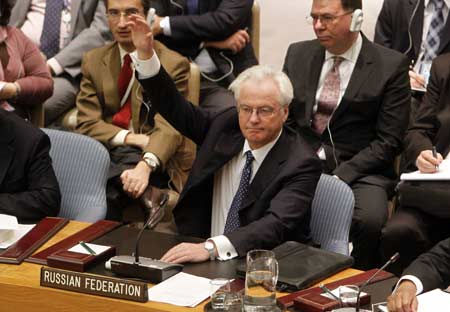
By Daan de Wit In an interview with the headline 'Former Obama advisor talks of possible military action in Iran', the interviewee, Dennis Ross, says: 'This is not the US versus Iran; this is not some Europeans versus Iran; this is the international community versus Iran.' Sure enough, it does seem like that at times. But the entire world isn’t wishing for a different Iran. Superpowers China and Russia are charting their own course, and in spite of their modern relationships with the West, there are still a lot of differences. This was made clear yet again recently when both of these countries prevented the passage of a resolution against Syria in the UN Security Council. ‘Outrageous', according to Susan Rice, American ambassador to the UN. U.S. Secretary of State Hillary Clinton seized upon the Security Council vote in calling for the formation of a group of like-minded nations to coordinate assistance to the Syrian opposition. These are statements which are reminiscent of the NATO invasion of Libya, especially for Russia and China.
At the end of last year, Medvedev addressed his people in a televised speech. The subject was the American missile defense shield in Europe. In no uncertain words he described the tough military measures he would take should it become necessary to protect Russia from the West. Meanwhile it is quite clear to Russia what the U.S. and Israel are up to when it comes to Russia’s ally Iran. The chairman of the Security Council of Russia and ex-director of the Russian intelligence service FSB, Nikolai Patrushev, says: 'At the moment, the US views Iran as its main problem. They are seeking to turn Tehran, their enemy, into a loyal partner, and for that purpose to change the ruling regime there by any means.' This is a view underlined by statements made by the aforementioned Dennis Ross, ex-member of Obama's National Security Council and former Iran advisor to Secretary Clinton, who says that the current American administration considers the risks of permitting a nuclear-armed Iran to be greater than the risks associated with military action. ‘Military action' sounds rather abstract, whereas Flynt and Hillary Leverett, each a member of the National Security Council under President Bush (until departing over their dissatisfaction with ‘Iraq’), make it sound a bit more concrete: 'We will call it what it would be, an illegitimate U.S. attack - against the Islamic Republic.'
____________________________________________________________________________
DeepJournal Meld je aan voor de gratis mailing list. |
 In a
In a ![PutinKhamenei [jpg]](../../../../images/uploaded/16/editorial/id=3947.jpg "PutinKhamenei [jpg]") The discussion surrounding Iran often has the theme of nuclear energy. But in fact it has to do with completely different sources of energy: oil and gas - and in particular who has the say over those energy sources. For the U.S., the energy supply is a matter of national security. Their own energy supply must be secured, and in so doing a strategic objective is achieved at the same time: heading off China and Russia at the pass. A powerful America is important not only to America, but to Israel as well, as is maintaining their own dominant position, which is guaranteed as long as that country is the only one in the region possessing a nuclear arsenal. So everyone involved in this conflict - Iran, the U.S. and the West, Israel, China, Russia, and including the Sunni populations in the region - all have great interests that differ sharply with each other. This turns the situation into a powder keg. And by the looks of it, a fuse has been set by Israel and/or the U.S., and they are standing there holding a match next to it.
The discussion surrounding Iran often has the theme of nuclear energy. But in fact it has to do with completely different sources of energy: oil and gas - and in particular who has the say over those energy sources. For the U.S., the energy supply is a matter of national security. Their own energy supply must be secured, and in so doing a strategic objective is achieved at the same time: heading off China and Russia at the pass. A powerful America is important not only to America, but to Israel as well, as is maintaining their own dominant position, which is guaranteed as long as that country is the only one in the region possessing a nuclear arsenal. So everyone involved in this conflict - Iran, the U.S. and the West, Israel, China, Russia, and including the Sunni populations in the region - all have great interests that differ sharply with each other. This turns the situation into a powder keg. And by the looks of it, a fuse has been set by Israel and/or the U.S., and they are standing there holding a match next to it.|
9 september 2013 |
Waarom ligt Syrië onder vuur? - Deel 4
Wie onder de oppervlakte kijkt, ziet dat Syrië onder vuur ligt vanwege de belangen van de betrokken partijen. 'Syrië' gaat over macht, geld, invloed en energie.
8 september 2013 |
Waarom ligt Syrië onder vuur? - 3
Wie vorm en inhoud scheidt, ziet dat de strijd om Syrië vooral niet gaat over waar het over lijkt te gaan. De vorm maskeert de inhoud. Syrië en Iran zijn stukken op een geopolitiek schaakbord.
7 september 2013 |
Waarom ligt Syrië onder vuur? - Deel 2
Bij grote militaire conflicten die aanzienlijke humantaire en economische gevolgen kunnen hebben, is het goed te kijken naar de belangen van de betrokken partijen en naar de rol van de media bij de verslaggeving van de feiten.
6 september 2013 |
Waarom ligt Syrië onder vuur? - Deel 1
Aan de oppervlakte is het duidelijk: de VS willen Syrië bevrijden van een wrede dictator die zijn bevolking met gifgas bestookt. Onder de oppervlakte is er iets heel anders aan de hand.
1 april 2013
Albert Spits: Creëer je eigen financiële veiligheid
Spits beschrijft hoe de euro richting de uitgang gaat en dat je intussen maar beter waarde voor je geld kunt kiezen. Hij raadt iedereen aan zich voor te bereiden op een systeemkrach.
|